Some of the best treatment centers in the country have empty beds.
At the same time, organizations with average clinical programs often maintain steady admissions pipelines.
That reality frustrates owners, executive directors, and admissions teams because it seems backward. If outcomes, staff quality, and patient care are excellent, admissions should follow naturally.
But in behavioral health, clinical excellence and admissions growth are not the same thing.
Families cannot choose a treatment center they never discover. Referral partners cannot recommend programs they rarely hear about. Search engines cannot showcase organizations that fail to communicate authority online.
The uncomfortable truth is that many treatment centers are operating under an outdated assumption: that great care automatically creates sustainable growth.
It doesn’t.
In today’s addiction treatment landscape, visibility, trust, reputation, accessibility, and search presence often determine which centers receive the first phone call. And the first phone call frequently determines who receives the admission.
Understanding that gap is one of the most important strategic challenges facing treatment providers today.
What Does It Mean When a Treatment Center Struggles to Generate Admissions?
A treatment center struggles to generate admissions when its patient inquiries, assessments, and enrollments remain below capacity despite offering quality clinical services.
The issue is not always clinical.
In many cases, the challenge is visibility, discoverability, positioning, trust, or conversion.
Common symptoms include:
- Empty beds despite strong outcomes
- Low call volume
- Dependence on a few referral sources
- Seasonal admissions volatility
- Rising marketing costs
- Weak website performance
- Poor local search visibility
- Inconsistent admissions forecasting
Many operators initially assume they have a marketing problem.
Often, they actually have a visibility and trust problem.
Why This Matters More Than Ever
The addiction treatment market has changed dramatically.
Ten years ago, referral networks often drove admissions.
Today, families frequently conduct extensive online research before speaking with anyone.
A parent searching for help may:
- Compare multiple treatment centers
- Read dozens of reviews
- Check Google Maps results
- Visit several websites
- Search for staff credentials
- Ask AI systems for recommendations
- Evaluate treatment philosophies
- Look for insurance information
- Review photos and facility credibility
The admissions journey no longer begins with a phone call.
It begins with a search.
Treatment centers that fail to recognize this shift often wonder why census remains stagnant despite delivering excellent care.
The Biggest Myth in Behavioral Health Marketing
“If We Build a Great Program, People Will Find Us”
This belief is responsible for more lost admissions than almost any other factor.
Clinical excellence matters enormously.
But clinical excellence is largely invisible until someone becomes a patient.
Families cannot directly evaluate:
- Clinical supervision
- Treatment protocols
- Team collaboration
- Outcome tracking
- Internal culture
Instead, they evaluate signals.
They assess what they can see.
That includes:
- Reviews
- Website quality
- Search rankings
- Brand credibility
- Professional content
- Online reputation
- Staff visibility
- Educational resources
In other words, people often judge quality based on trust indicators before they ever experience actual care.
How Family Search Behavior Has Changed
One of the most overlooked admissions challenges is that treatment centers often market based on how providers think.
Families search differently.
Clinical teams focus on diagnoses.
Families focus on urgency.
A treatment provider might discuss:
- Substance use disorder
- Co-occurring disorders
- Evidence-based care
- Continuum of care
Families search:
- “Help for my son addicted to fentanyl”
- “Alcohol rehab near me”
- “Detox that takes insurance”
- “Best rehab for anxiety and addiction”
- “Can someone force treatment”
These searches reveal intent.
Organizations that align their digital presence with real-world search behavior gain a significant admissions advantage.
Organizations that focus only on internal terminology often become invisible during critical decision-making moments.
The Visibility Problem Most Treatment Centers Never Diagnose
Many operators track admissions.
Few track discoverability.
A treatment center can lose admissions long before the admissions department becomes involved.
Consider the typical journey:
- Family searches Google.
- Competitor appears first.
- Family clicks competitor.
- Competitor earns trust.
- Competitor receives call.
- Competitor conducts assessment.
- Competitor receives admission.
The losing treatment center may never know the opportunity existed.
No phone call.
No inquiry.
No lead.
No data.
This invisible loss is occurring every day across addiction treatment, detox, residential treatment, PHP, IOP, MAT, sober living, dual diagnosis, and mental health treatment programs.
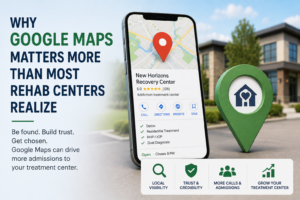
Why Google Maps Has Become an Admissions Channel
Many executives still think of Google Business Profiles as a local SEO tactic.
In reality, Google Maps has become a direct admissions platform.
Families increasingly trust local search results because they contain:
- Reviews
- Photos
- Directions
- Contact information
- Business legitimacy signals
When a center appears prominently in local map results, it gains immediate credibility.
When it does not appear, families often assume it is less established than competitors.
For organizations offering addiction treatment, detox, outpatient treatment, or behavioral health services, local visibility directly affects admissions opportunities.
The Trust Gap Is Often Bigger Than the Visibility Gap
Getting found is only the first challenge.
Earning trust is the second.
Many treatment centers attract website traffic but fail to convert visitors into calls.
Why?
Because visitors remain uncertain.
Common trust gaps include:
Weak Clinical Authority Signals
Families want reassurance.
They want to know:
- Who provides treatment
- What credentials exist
- How care is delivered
- Why the organization is qualified
Generic websites rarely answer these questions effectively.
Poor Reputation Management
Reviews matter.
Not because families expect perfection.
Because they want evidence that real people have been helped.
A treatment center with strong reviews frequently outperforms a larger competitor with weak reputation signals.
Inconsistent Messaging
Many websites discuss treatment programs but fail to clearly communicate outcomes, expertise, specialization, or differentiators.
Confused visitors rarely become admissions.
Why Referral Relationships Alone Are No Longer Enough
Referral partnerships remain valuable.
But they are no longer sufficient for predictable growth.
Hospitals, therapists, interventionists, EAPs, physicians, and community organizations continue to influence admissions.
However, families often conduct independent research before making a decision.
Even when a referral partner recommends a facility, the family usually searches online before calling.
This means referral marketing and search visibility are now interconnected.
A strong referral source may generate awareness.
Digital credibility often determines whether the admission actually happens.
What Treatment Centers That Consistently Grow Admissions Do Differently
The most successful organizations tend to share several characteristics.
They Build Visibility Across Multiple Channels
They do not rely on a single source of admissions.
They invest in:
- Local visibility
- Organic search
- Reputation management
- Referral development
- Content authority
- Brand trust
This diversification creates stability.
They Own Treatment-Specific Search Categories
High-performing organizations often establish authority around specific service lines.
Examples include:
- Addiction Treatment Center SEO
- Detox Center SEO
- Residential Rehab SEO
- Outpatient Rehab SEO
- PHP SEO
- IOP SEO
- MAT SEO
- Sober Living SEO
- Dual Diagnosis SEO
- Teen Rehab SEO
- Luxury Rehab SEO
- Mental Health Treatment SEO
- Behavioral Health SEO
Instead of competing broadly, they become recognized experts in targeted treatment categories.
They Understand Conversion Psychology
Traffic alone does not generate admissions.
Trust generates admissions.
Successful centers optimize:
- Website experience
- Mobile usability
- Call accessibility
- Insurance transparency
- Clinical credibility
- Family education
Every improvement increases the likelihood that a visitor becomes a caller.
How AI Search Is Changing Admissions Marketing
A major shift is already underway.
Families increasingly use AI systems to research treatment options.
Instead of searching only on Google, they ask:
- What is the best rehab for fentanyl addiction?
- What treatment center specializes in dual diagnosis?
- What should I look for in a detox program?
- How do I compare residential treatment centers?
AI platforms prioritize trustworthy, authoritative, well-structured information.
This means treatment centers that publish genuinely helpful content gain advantages not only in traditional search but also in AI-generated recommendations and summaries.
Organizations that fail to establish topical authority may become less visible across both search engines and AI systems.
What Mistakes Do Treatment Centers Commonly Make?
Treating Marketing as a Lead Generation Function Only
Admissions growth begins before lead generation.
It starts with visibility and trust.
Focusing Only on Rankings
Rankings matter.
Admissions matter more.
Visibility without conversion rarely produces growth.
Neglecting Local Search
Many organizations chase national traffic while ignoring high-intent local opportunities.
Underinvesting in Reputation
Reviews, testimonials, and social proof influence admissions decisions every day.
Creating Generic Content
Families need answers.
Search engines and AI systems reward expertise.
Generic content rarely earns either.
What Should Treatment Centers Do Differently?
Treatment centers should focus on becoming the most trusted source of information and care within their market rather than simply trying to generate more traffic.
That means:
- Improving local visibility
- Strengthening Google Business Profiles
- Building treatment-specific authority
- Publishing expert educational content
- Enhancing reputation management
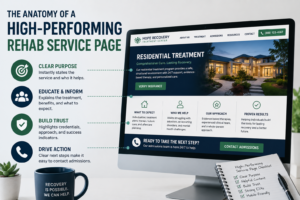
- Improving website conversion pathways
- Supporting referral relationships
- Monitoring admissions attribution
- Preparing for AI-driven search behavior
The organizations that consistently generate admissions are rarely the loudest marketers.
They are usually the most visible, trusted, and discoverable providers when families need help most.
The Real Admissions Equation
Many treatment centers believe the formula is:
Clinical Quality → Admissions
In reality, the modern formula looks more like:
Clinical Quality + Visibility + Trust + Reputation + Accessibility + Conversion = Admissions Growth
Clinical excellence remains the foundation.
But visibility determines whether families find you.
Trust determines whether they call.
Conversion determines whether they admit.
Without those elements, even exceptional treatment programs can struggle to fill beds.
The treatment centers that understand this reality are positioning themselves for long-term growth in an increasingly competitive and AI-driven behavioral health marketplace.
Frequently Asked Questions
Why do treatment centers with excellent clinical programs still struggle to generate admissions?
Because clinical quality alone does not guarantee visibility. Families must first discover, trust, and contact a treatment center before admissions can occur.
What is the biggest admissions challenge facing treatment centers today?
The biggest challenge is often discoverability. Many providers are invisible during critical online searches where families begin their decision-making process.
How important is Google Maps for rehab admissions?
Google Maps is extremely important because it influences local visibility, trust, reviews, and direct inquiries from families seeking immediate help.
Does SEO really impact treatment center admissions?
Yes. Effective SEO increases visibility during high-intent searches, helping treatment centers attract qualified inquiries from prospective patients and families.
Why are referrals alone no longer enough?
Families increasingly verify referrals online. Even when a provider is recommended, digital credibility often influences the final decision.
What role do reviews play in rehab admissions?
Reviews help establish trust. Families frequently use reviews to evaluate credibility, quality of care, and patient experiences.
How does AI search affect addiction treatment marketing?
AI platforms increasingly summarize and recommend providers based on authority, expertise, trustworthiness, and content quality.
What is the difference between traffic and admissions?
Traffic measures website visitors. Admissions measure actual enrollments. A treatment center can have substantial traffic but weak conversion performance.
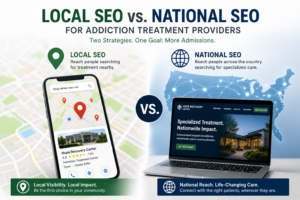
Should treatment centers focus on local SEO or national SEO?
Most organizations benefit from both. Local SEO captures nearby demand, while national SEO expands visibility for specialized treatment programs.
How can treatment centers improve admissions without increasing advertising spend?
Improving trust signals, local visibility, reputation management, website conversion rates, and content authority can often increase admissions without additional advertising costs.
Why is reputation management important for behavioral health organizations?
Reputation influences family decision-making. Strong reviews and positive public perception increase trust and inquiry rates.
What is the first step toward improving admissions performance?
The first step is understanding where admissions opportunities are being lost—visibility, trust, conversion, referral engagement, or search presence.
The Rehab SEO Specialists helps addiction treatment providers understand the connection between visibility, trust, search behavior, and admissions growth. In a market where families increasingly rely on Google, Maps, reviews, and AI-driven research, the organizations that win are not always the largest—they are the ones that become the most discoverable and trusted when help is needed most.