
Most treatment centers assume the admissions process begins when the phone rings.
In reality, it often ends before that call ever happens.
By the time a family reaches out to a treatment provider, they’ve usually spent hours or even days researching facilities, comparing programs, reading reviews, evaluating websites, searching Google Maps, asking AI platforms questions, and quietly eliminating providers they don’t trust. The centers that never receive the call rarely know they were even considered.
This is one of the biggest blind spots in behavioral health marketing today. At The Rehab SEO Specialists, we’ve seen many organizations invest heavily in admissions staff, CRM systems, and call tracking while overlooking the dozens of decisions families make long before speaking with anyone. Understanding those invisible moments can dramatically improve admissions performance without increasing inquiry volume.
The Real Admissions Funnel Starts Earlier Than Most Centers Think
Families rarely search for a rehab center with complete certainty.
Instead, they begin with uncertainty.
Someone may search:
- “Best rehab for alcohol addiction”
- “Dual diagnosis treatment near me”
- “Detox that accepts my insurance”
- “Residential treatment for my son”
- “Drug rehab with trauma therapy”
At this stage, they are not choosing a facility.
They are narrowing a list.
Every search result becomes an interview.
Every website becomes an impression.
Every review becomes evidence.
Every unanswered question becomes a reason to continue searching.
By the time a family reaches your admissions team, your marketing has already answered dozens of questions without anyone on your staff participating.
What Does It Mean to Lose an Admission Before the Phone Rings?
Treatment centers lose admissions before the phone rings when prospective families eliminate them during the research phase.
That elimination may happen because of poor visibility, weak trust signals, outdated information, confusing messaging, or a website that fails to answer important questions.
Most providers never realize this is happening because these lost prospects never become leads.
Families Are Looking for Confidence, Not Marketing
Behavioral health is unlike almost any other purchase.
Families are making decisions under stress.
They’re worried.
They’re exhausted.
Many are carrying guilt, fear, uncertainty, and urgency simultaneously.
That changes how they search.
Instead of looking for clever branding, they’re searching for reassurance.
They want to know:
- Can this center help?
- Can I trust these people?
- Is my loved one safe here?
- Do they understand our situation?
- Will insurance work?
- What happens after detox?
- Is this treatment evidence-based?
If your website focuses primarily on your organization instead of answering these concerns, families often move on without ever contacting you.
Search Visibility Is No Longer Enough
Five years ago, ranking well on Google often generated inquiries.
Today, visibility alone is only the beginning.
Treatment centers must now compete across multiple discovery platforms:
- Traditional Google Search
- Google Maps
- Google AI Overviews
- ChatGPT
- Gemini
- Perplexity
- Voice search
- Local recommendations
- Online reviews
Families rarely rely on a single source.
Instead, they validate information across several platforms before making a decision.
If those platforms present inconsistent information or weak authority signals, trust declines quickly.
Your Website Is Either Reducing Anxiety or Increasing It
Many rehab websites unintentionally create friction.
Common problems include:
Generic headlines.
Stock photography that feels staged.
Vague treatment descriptions.
Poor mobile performance.
Missing clinician information.
Minimal explanation of care levels.
No discussion of family involvement.
Little transparency around the admissions process.
These aren’t just website issues.
They’re admissions issues.
Every unanswered question creates another opportunity for a competing treatment center to earn the family’s confidence.
Reviews Influence More Than Reputation
Treatment centers often view reviews as a branding asset.
They’re much more than that.
Reviews validate expectations.
Families aren’t necessarily searching for perfect ratings.
They’re searching for patterns.
Do former clients mention compassionate staff?
Do families describe feeling supported?
Are concerns addressed professionally?
Is leadership engaged?
Authentic feedback builds credibility because it reflects real experiences rather than marketing claims.
This is particularly important for Addiction Treatment, Detox, Residential Treatment, and Mental Health Treatment providers where emotional trust heavily influences decision-making.
The Hidden Cost of Inconsistent Messaging
Many organizations unintentionally describe themselves differently across various platforms.
Their website says one thing.
Google Business Profile says another.
Directory listings contain outdated services.
AI-generated summaries reference incomplete information.
Families notice these inconsistencies, even subconsciously.
Consistency reinforces credibility.
Confusion creates hesitation.
Behavioral Health Marketing Is Becoming Entity-Driven
Search engines increasingly evaluate organizations as entities rather than simply websites.
That means Google and AI systems attempt to understand:
Who you are.
What services you provide.
Where you operate.
Who your clinicians serve.
What conditions you treat.
How others reference your organization.
This benefits treatment centers that build comprehensive topical authority across areas like:
- Detox Center SEO
- Residential Rehab SEO
- PHP SEO
- IOP SEO
- MAT SEO
- Dual Diagnosis SEO
- Behavioral Health SEO
Rather than creating isolated marketing pages, successful providers develop connected ecosystems of trustworthy information.
Families Research Treatment, Not Just Facilities
One important shift is how people search.
Instead of looking only for providers, families increasingly research conditions.
Examples include:
Alcohol withdrawal.
Opioid addiction.
Anxiety with substance abuse.
Trauma treatment.
Medication-assisted treatment.
Family therapy.
Relapse prevention.
This creates opportunities for treatment centers to educate before they sell.
Organizations that answer these questions thoroughly become trusted resources earlier in the decision process.
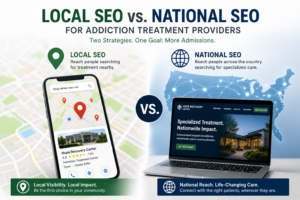
Local Trust Matters Even for National Programs
Many residential treatment centers attract clients nationally.
That doesn’t reduce the importance of local visibility.
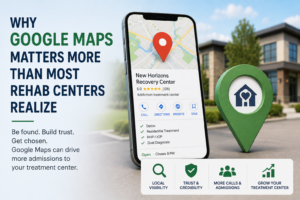
Google Business Profile.
Local reviews.
Nearby landmarks.
Community involvement.
Accurate location information.
These signals reinforce legitimacy.
Even families traveling across the country often want confidence that the organization is well established within its own community.
Admissions Teams Cannot Fix Marketing Problems Alone
Admissions coordinators are incredibly important.
But they can only convert people who actually contact the center.
If marketing consistently loses prospects during the research phase, admissions performance will always appear weaker than it truly is.
This often creates the false assumption that call handling is the problem.
Sometimes the real issue is that the highest-quality prospects never reached the phone.
AI Search Is Changing Family Research
Increasingly, families ask AI questions like:
“What is the best rehab for veterans?”
“Which rehab centers treat trauma?”
“What should I look for in residential treatment?”
AI systems summarize information instead of simply displaying websites.
Organizations producing comprehensive, trustworthy content are more likely to be referenced within these answers.
That requires expertise, depth, clarity, and topical authority rather than traditional keyword-focused SEO.
The Most Successful Treatment Centers Build Trust Before Asking for Contact
High-performing treatment providers understand something important.
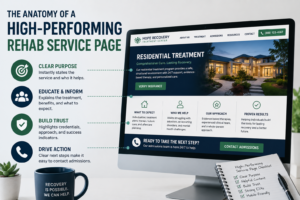
Every webpage has a job.
Some pages educate.
Some reduce fear.
Some explain treatment.
Some answer financial questions.
Some introduce clinicians.
Some support families.
Only after enough confidence has been built does contacting admissions become the natural next step.
That sequence mirrors how people actually make healthcare decisions.
Strategic Questions Every Treatment Center Should Ask
Instead of asking:
“Why aren’t more people calling?”
Consider asking:
- What questions remain unanswered on our website?
- What reasons might families have for eliminating us?
- Are we educating before selling?
- Does every platform accurately represent our organization?
- Would a family unfamiliar with us immediately trust us?
Those questions often reveal opportunities that analytics alone cannot.
Winning the Admission Before the First Call
Treatment centers don’t lose admissions only because competitors outrank them.
They lose admissions because trust is built long before conversations begin.
Families quietly evaluate providers through search results, reviews, educational content, local visibility, website experience, and increasingly through AI-generated summaries. Every one of those touchpoints shapes whether your admissions phone rings at all.
Organizations that consistently invest in authority, transparency, educational content, and a patient-centered digital experience position themselves to earn trust before the first conversation ever takes place. In today’s behavioral health landscape, that early trust is often the deciding factor between gaining an admission and never knowing the opportunity existed.
Frequently Asked Questions
Why do treatment centers lose admissions before receiving inquiries?
Families often eliminate providers during their online research based on trust, visibility, website quality, reviews, and available information before ever contacting admissions.
How important is Google Business Profile for addiction treatment centers?
It’s extremely important. Google Business Profile supports local visibility, reinforces legitimacy, and often serves as one of the first impressions families encounter.
Does AI search affect behavioral health marketing?
Yes. Platforms like ChatGPT, Gemini, Google AI Overviews, and Perplexity increasingly influence how families research addiction treatment options before visiting websites.
What is topical authority in addiction treatment SEO?
Topical authority is built by publishing comprehensive, interconnected content covering addiction treatment services, levels of care, mental health, recovery topics, and related patient questions.
Why do treatment center websites fail to convert visitors?
Many websites focus too heavily on the organization rather than answering the questions families actually have during their decision-making process.
Are online reviews still important if a center ranks well?
Absolutely. Rankings generate visibility, but reviews often determine whether families trust a provider enough to make contact.
Should treatment centers create content for every level of care?
Yes. Dedicated educational resources for Detox, Residential Treatment, PHP, IOP, MAT, Dual Diagnosis, and Mental Health Treatment strengthen authority and improve visibility.
How does user experience affect admissions?
Slow websites, confusing navigation, unclear messaging, and poor mobile performance increase abandonment before families ever contact admissions.
What role does educational content play in admissions growth?
Educational content builds credibility, answers family concerns, supports AI visibility, and establishes trust long before admissions conversations begin.
What should treatment center leadership prioritize first?
Leadership should evaluate whether their organization’s digital presence genuinely answers family questions, demonstrates expertise, builds trust, and supports informed decision-making across every stage of the admissions journey.