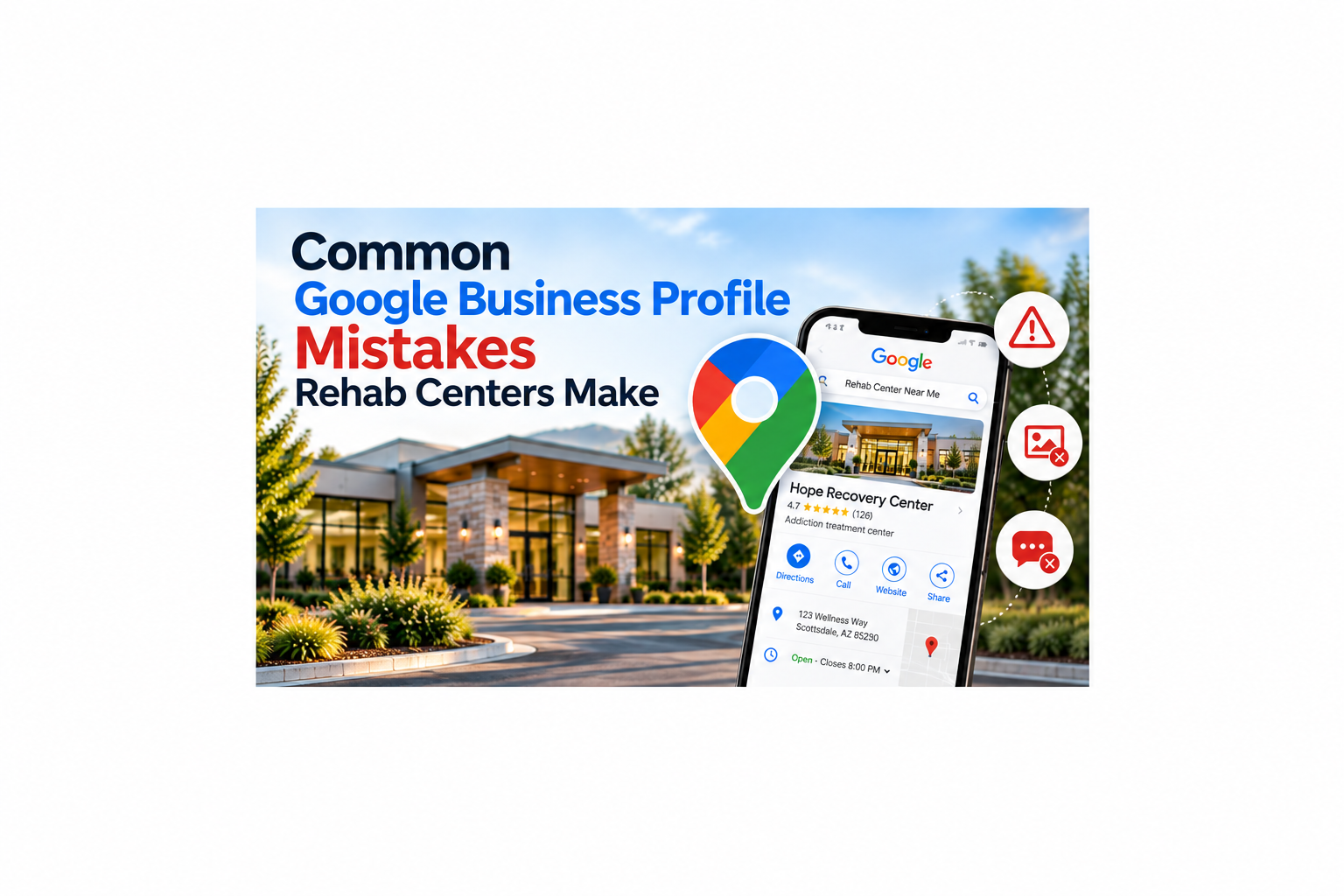
A rehab center can offer excellent treatment and still lose potential admissions because of an incomplete or poorly managed Google Business Profile.
When families search for detox, alcohol rehab, or addiction treatment nearby, Google Maps often influences which facilities they consider. Incorrect information, weak reviews, misleading photographs, or outdated contact details can create doubt before someone even visits your website.
For treatment organizations, Google Business Profile optimization is about more than rankings. It connects local visibility with patient trust and admissions.
The Rehab SEO Specialists helps addiction treatment organizations develop search strategies that connect local visibility with qualified admissions opportunities.
Why Does Google Business Profile Matter for Rehab Centers?
Google Business Profile helps eligible treatment facilities appear in Google Search and Maps while providing essential information about their services, location, reputation, and contact details.
A properly managed profile supports three important objectives: improving local visibility, building confidence among prospective patients and families, and making it easier to contact admissions.
However, several common mistakes can undermine these opportunities.
7 Common Google Business Profile Mistakes Rehab Centers Make
1. Choosing Incorrect Business Categories
Selecting categories based on popular keywords rather than actual services can confuse prospective patients and weaken geographic relevance.
A detox facility, residential treatment center, and outpatient program have different purposes.
Choose categories that accurately represent the services provided at each location.
2. Sending Every Location to the Homepage
Multi-location organizations frequently connect every Google Business Profile to their corporate homepage.
This forces visitors to search again for the facility they originally discovered.
Instead, connect each profile to its relevant location page whenever appropriate. This creates a clearer path from Google Maps to admissions.
3. Using Generic or Outdated Photographs
Families want to understand where treatment takes place.
Generic stock photography provides little information about the actual facility.
Use accurate, current photographs of treatment facilities, entrances, grounds, and appropriate common areas. Authentic imagery can help establish confidence before the first conversation.
4. Neglecting Reviews and Reputation Management
Reviews influence how prospective patients and families evaluate treatment providers.
Ignoring feedback or responding carelessly can damage credibility.
Develop an ethical review-management process that monitors feedback, respects patient privacy, and identifies recurring operational concerns.
Never offer incentives in exchange for positive reviews or disclose patient information in public responses.
5. Creating Profiles for Locations That Don’t Qualify
Expanding into new geographic markets does not automatically justify creating additional Google Business Profiles.
Organizations should distinguish between actual treatment facilities, administrative offices, virtual services, and geographic markets they serve.
Only create profiles for eligible operations that comply with Google’s requirements.
6. Publishing Inconsistent Facility Information
Conflicting information across Google Business Profiles, websites, and directories creates unnecessary uncertainty.
Each location should consistently communicate its address, contact information, hours, treatment programs, and admissions details.
This is especially important for multi-location organizations offering different levels of care.
7. Measuring Rankings Instead of Admissions
Higher Google Maps visibility does not automatically produce qualified admissions.
Treatment organizations should examine which locations generate meaningful calls, appropriate inquiries, and admissions opportunities.
A facility receiving fewer visitors but generating more qualified inquiries may provide greater business value than one attracting substantial irrelevant traffic.
The objective is qualified treatment demand, not visibility alone.
How Google Business Profiles Support AI Search Visibility
AI-powered search systems increasingly help people discover and evaluate healthcare information.
Accurate Google Business Profiles, consistent facility information, authoritative location pages, and credible third-party references can contribute to a clearer online identity.
For multi-location organizations, every facility should be easy to identify and distinguish.
However, no Google Business Profile optimization guarantees inclusion in AI-generated answers.
What Should Rehab Centers Do Differently?
Treat Google Business Profile management as part of your admissions and reputation strategy.
Make sure every eligible location has accurate information, appropriate categories, authentic photographs, a relevant website destination, and an ethical review-management process.
Connect your Google Business Profile strategy with Addiction Treatment Center SEO, Detox Center SEO, Residential Rehab SEO, and Outpatient Rehab SEO when those services are relevant.
Most importantly, evaluate whether local visibility is helping prospective patients find, understand, and contact the right treatment facility.
To strengthen your organization’s Google Maps presence and local search strategy, schedule a free consultation with The Rehab SEO Specialists.
Frequently Asked Questions
1. Does every rehab center need a Google Business Profile?
Eligible facilities should generally consider creating one to establish their presence in Google Search and Maps.
2. Should each treatment location have its own profile?
Separate eligible facilities can have individual profiles that accurately represent their operations.
3. Can Google Business Profile improve local SEO?
Yes. An accurate, relevant profile supports local visibility, although rankings depend on multiple factors.
4. Should Google Business Profiles link to location pages?
When appropriate, linking to the specific facility page provides a more relevant experience for prospective patients.
5. Do Google reviews matter for rehab centers?
Yes. Reviews can influence trust and treatment decisions. Organizations should manage them ethically while protecting patient privacy.
6. Can rehab centers create profiles in cities without physical locations?
Not simply to target additional markets. Every profile must meet Google’s eligibility requirements.
7. How often should profiles be updated?
Review them regularly and update information whenever facility details or operations change.
8. What photographs should treatment centers use?
Authentic, current photographs that accurately represent the facility and its environment.
9. Can Google Business Profile improve admissions?
It can help prospective patients discover and contact a facility. Actual admissions depend on additional factors, including clinical suitability and availability.
10. Does Google Business Profile help with AI search?
Accurate profiles can contribute to consistent online information that AI systems may use, but inclusion in AI-generated responses is not guaranteed.