
Operating multiple addiction treatment locations should create a competitive advantage. Too often, it creates a visibility problem instead.
A treatment organization may have strong clinical programs, experienced admissions teams, and locations across several markets, yet still lose searches to smaller competitors that have built stronger local authority. Working with a specialized behavioral health marketing partner such as The Rehab SEO Specialists can help multi-location organizations identify these visibility gaps and build a search strategy around the way prospective patients and families actually look for care.
The challenge is that families rarely search for a “multi-location behavioral health organization.” They search for solutions: detox near me, alcohol rehab, residential treatment, IOP, dual diagnosis treatment, or help for a loved one in a specific city.
Multi-location treatment centers compete more effectively when they stop treating every facility as another page on a corporate website and start building each location as a credible local treatment destination—while using the authority of the larger organization to strengthen the entire network.
What Does Competing as a Multi-Location Treatment Center Actually Mean?
For a multi-location treatment organization, competition happens at several levels simultaneously.
You are competing for local Google visibility, Google Maps placement, organic search rankings, reputation, referral relationships, admissions, and increasingly, visibility within AI-generated answers.
You are also competing for trust.
A family comparing three treatment centers may know nothing about domain authority, backlinks, or search rankings. They notice whether a facility appears legitimate, whether the program matches their needs, whether reviews feel credible, and whether they can quickly understand what happens next.
That makes multi-location growth both a visibility problem and a trust problem.
The Biggest Mistake: Treating Locations Like Duplicate Landing Pages
One of the most common weaknesses in multi-location addiction treatment SEO is location-page duplication.
A provider creates pages for Los Angeles, San Diego, Phoenix, and Denver, changes the city name and a few paragraphs, and considers its local strategy complete.
That rarely creates meaningful local authority.
Each location should answer questions specific to that market:
- What treatment is actually provided at this facility?
- Is detox available there or somewhere else in the organization?
- Does the location offer residential treatment, PHP, IOP, MAT, or dual diagnosis care?
- Who is the program designed to serve?
- What geographic areas commonly generate admissions?
- What should families expect when contacting this particular facility?
- What makes this location relevant to someone comparing treatment options nearby?
This is where Addiction Treatment Center SEO becomes much more sophisticated than simply inserting geographic keywords into existing copy.
Every Facility Needs Its Own Search Identity
Google needs to understand what each location represents.
Families need to understand it even faster.
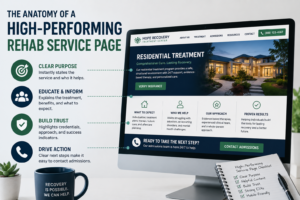
That means each facility should have its own strong location page, accurate Google Business Profile, consistent contact information, relevant treatment information, reviews, photographs, clinical details, and supporting content.
The objective isn’t to make every location look different for the sake of originality. It is to accurately communicate the differences that already exist.
A detox facility should develop authority around detox-related searches. An outpatient location offering PHP and IOP should establish relevance around those services. A mental health or dual diagnosis program should not simply inherit generic “rehab” language from the corporate website.
This creates clearer signals for both search engines and prospective patients.
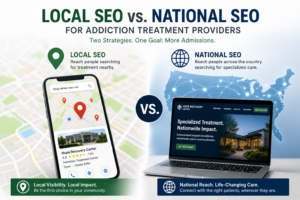
Local SEO and National SEO Should Work Together
Multi-location organizations frequently make one of two strategic errors.
They either build everything around the corporate brand and neglect individual markets, or create dozens of local pages without developing meaningful organization-wide authority.
The strongest strategy does both.
The main website can establish broad authority around addiction treatment, behavioral health, substance use disorders, treatment levels, insurance, admissions, and educational topics.
Individual facilities can then develop deeper geographic relevance.
For example, an organization may have a strong national resource explaining how intensive outpatient treatment works. Individual IOP locations can support that authority with locally relevant program pages.
The result is an interconnected search ecosystem rather than dozens of facilities competing independently.
This same principle applies to Detox Center SEO, Residential Rehab SEO, PHP SEO, IOP SEO, MAT SEO, Dual Diagnosis SEO, and Mental Health Treatment SEO.
Google Maps Can Become a Multi-Location Growth Engine
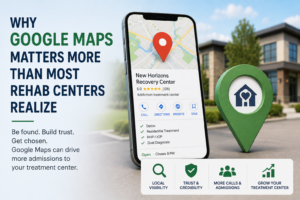
For high-intent local searches, Maps visibility can influence admissions significantly.
Someone searching for an alcohol rehab or drug treatment program nearby may interact with the map results before visiting traditional organic listings.
Yet Google Business Profiles are frequently treated as administrative listings instead of strategic assets.
Each eligible treatment location should have accurate categories, hours, contact information, website destinations, photographs, reviews, services, and facility information.
More importantly, the website page connected to that profile should reinforce the same entity.
A common mistake is sending every Google Business Profile to the organization’s homepage. A prospective patient in one market should not have to navigate a national website to determine whether treatment is actually available nearby.
Reduce that friction.
Reputation Must Be Managed at the Location Level
Reviews influence more than rankings.
They influence confidence.
Families dealing with addiction are often making decisions under emotional pressure. They may be comparing facilities late at night, calling multiple admissions departments, checking insurance options, and reading reviews for clues about how patients and families are treated.
For a multi-location provider, one strong corporate reputation does not automatically compensate for weak individual facility reputations.
Each location develops its own digital footprint.
Reputation management therefore needs to be operational—not simply a marketing campaign.
Organizations should have ethical, compliant processes for monitoring feedback, responding appropriately, identifying recurring concerns, and making accurate facility information easy to verify.
Admissions Data Should Influence Search Strategy
This is where sophisticated treatment organizations can outperform generic competitors.
Marketing teams often analyze rankings. Admissions teams understand actual demand.
Combine the two.
Look at the questions callers ask. Examine which programs generate qualified admissions. Identify geographic patterns in inquiries. Determine which searches appear to produce people who actually fit the program.
A page receiving thousands of visits but almost no appropriate admissions may be less valuable than a highly specific page producing 40 visits and several qualified calls.
That distinction matters enormously in behavioral health marketing.
Traffic is not the ultimate KPI.
Qualified treatment demand is.
Families Search Differently Than Marketing Teams Think
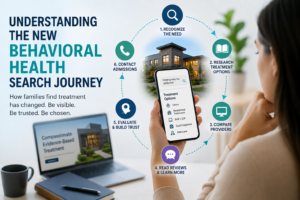
Search behavior changes as urgency increases.
Someone beginning research may ask:
“What is residential addiction treatment?”
Later, the searches become more specific:
“residential alcohol treatment near me”
“dual diagnosis rehab in Phoenix”
“detox that accepts my insurance”
Eventually, the search may become a facility name followed by “reviews,” “cost,” “insurance,” or “complaints.”
Multi-location organizations should have useful content across this entire decision journey.
That includes informational resources, service pages, location pages, insurance information, admissions guidance, clinician information, facility details, FAQs, and transparent explanations of levels of care.
The objective is not to dominate every keyword.
It is to remain useful as the family’s questions become more specific.
AI Search Is Changing Treatment Center Visibility
ChatGPT, Google AI experiences, Gemini, Perplexity, and other answer engines are creating another discovery layer.
The organizations most likely to benefit will be those whose digital presence is easy to understand.
AI systems need clear answers to basic questions:
Who is the provider?
Where are its facilities?
What does each location treat?
Which levels of care are available?
What populations are served?
What evidence supports those claims?
Consistency matters.
If the website describes one service mix, directories show another, Google Business Profiles contain outdated information, and individual facility pages are vague, the organization’s digital identity becomes harder for both people and machines to interpret.
AI search visibility therefore begins with something much less glamorous than chasing AI citations:
Make the organization exceptionally easy to understand and verify.
What Should Multi-Location Treatment Centers Do Differently?
Build the strategy around facilities, services, markets, and patient intent—not around a list of keywords.
Give every legitimate location enough information and supporting authority to stand on its own. Connect those locations through a strong organizational architecture. Align local SEO, content, reputation, admissions intelligence, conversion optimization, and brand authority.
Then measure success beyond rankings.
Track qualified calls, admissions opportunities, geographic demand, service-line performance, conversion rates, and ultimately the relationship between visibility and census.
The competitive advantage of having multiple locations is not simply having more addresses.
It is having more opportunities to establish trusted treatment entities in the markets where people actually need care.
Organizations that recognize that distinction can build something far more defensible than rankings: a network of locally trusted facilities supported by organization-wide authority. If your treatment organization is ready to strengthen its visibility across multiple markets and turn that visibility into qualified admissions opportunities, schedule a free consultation with The Rehab SEO Specialists.
Frequently Asked Questions
Should every treatment center location have its own webpage?
Yes. Each legitimate facility should generally have a dedicated page explaining its location, programs, levels of care, contact information, admissions process, and other information relevant to prospective patients and families.
Should every location target the same keywords?
No. Keyword strategy should reflect what each facility actually provides. A detox facility and an outpatient IOP location should not have identical search strategies.
Can multiple treatment locations compete against each other in Google?
They can, especially when pages are nearly identical or Google cannot clearly distinguish the facilities. Strong site architecture and genuinely location-specific content help establish clearer relevance.
How important is Google Maps for addiction treatment centers?
Very important for location-driven searches. Accurate Google Business Profiles, strong location pages, reputation signals, and consistent facility information can improve both visibility and user confidence.
Should every Google Business Profile link to the homepage?
Usually not. When appropriate, the profile should point users toward the most relevant page for that specific facility, reducing unnecessary steps between search and admissions.
How should a treatment organization measure SEO success?
Rankings and traffic are useful diagnostic metrics, but qualified calls, admissions opportunities, conversion rates, service-line demand, and geographic performance provide a much stronger picture of business impact.
Does a national brand still need local SEO?
Yes. National authority and local visibility solve different problems. A strong corporate brand does not automatically guarantee visibility when someone searches for treatment in a specific market.
How can admissions teams improve SEO strategy?
Admissions teams hear the language prospective patients and families actually use. Their call data can reveal recurring questions, insurance concerns, geographic demand, treatment needs, and gaps between marketing messaging and real-world decision-making.
How can multi-location treatment centers improve AI search visibility?
Start by making every facility and service easy to identify and verify. Clear organization, accurate program information, authoritative educational content, consistent entity information, and credible third-party signals give AI systems stronger information to understand.
What creates the biggest competitive advantage for multi-location treatment organizations?
Integration. The strongest organizations connect local visibility, national authority, reputation, content, user experience, admissions intelligence, and conversion strategy rather than treating them as separate marketing projects.