A rehab service page has a bigger job than simply explaining what a treatment center offers. It needs to help a family understand the service, answer important questions, establish trust, appear in search results, and make the next step feel clear.
That is especially important when someone is searching for detox, residential treatment, PHP, IOP, MAT, dual diagnosis care, or another behavioral health service. They may be researching for themselves or trying to make a decision for someone they love. They do not have time to decode vague marketing language.
A high-performing rehab service page connects search visibility with clinical clarity and admissions readiness. It gives Google and AI systems enough context to understand the service while giving real people the information they need to take action.
What Is a High-Performing Rehab Service Page?
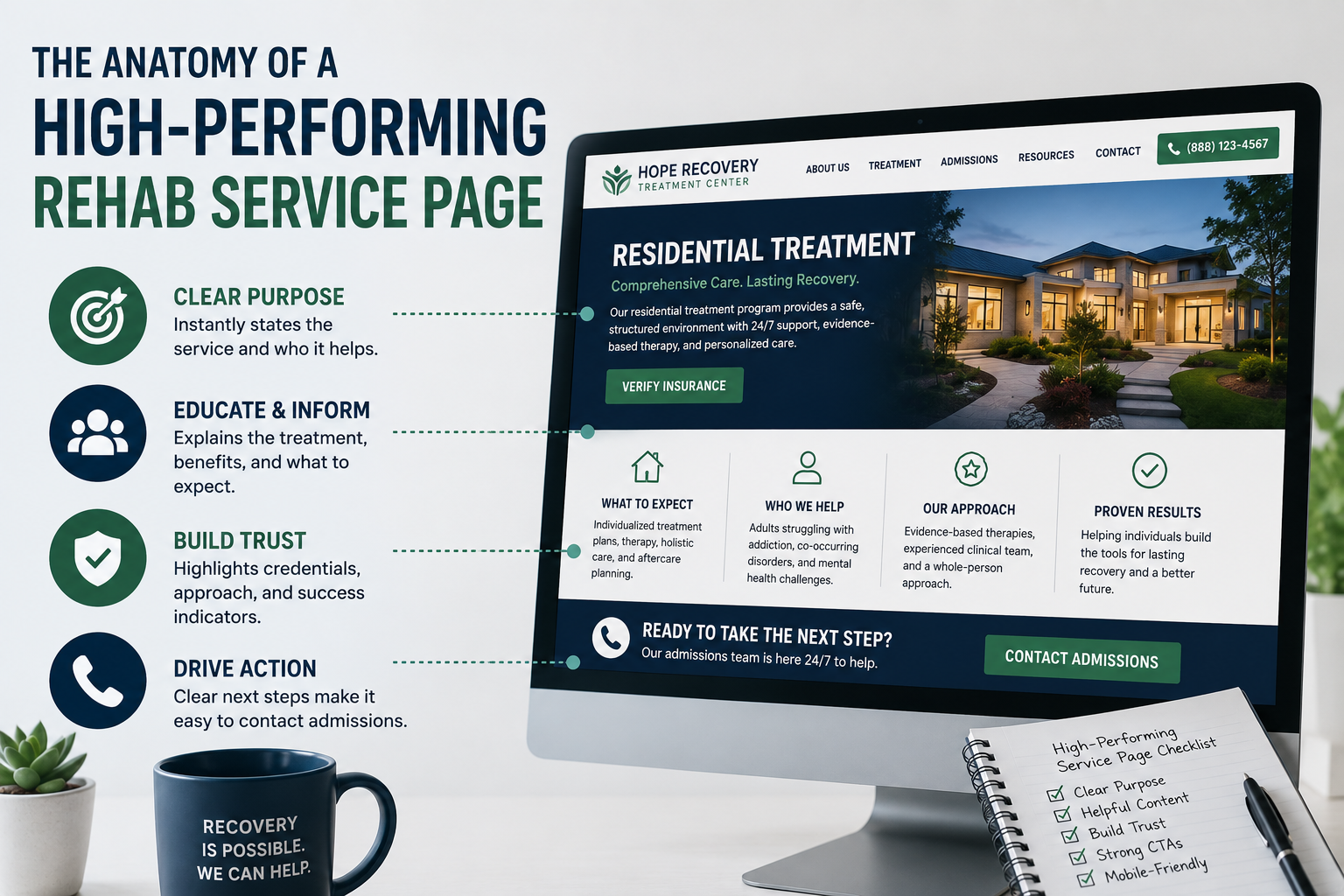
A high-performing rehab service page is a dedicated page that clearly explains one treatment service, matches the searcher’s intent, demonstrates credibility, and guides qualified visitors toward an appropriate next step.
It should answer four basic questions quickly:
- What treatment do you provide?
- Who is it designed for?
- What can someone expect?
- How can they learn more or begin the admissions process?
The best pages answer these questions without sounding like advertisements.
Why Does the Service Page Matter?
Many treatment centers make the mistake of placing every program on one general “Our Services” page.
That creates a problem.
Someone searching specifically for residential treatment should not have to navigate through detox, outpatient care, MAT, and unrelated programs before finding the information they need.
A dedicated service page gives search engines a clearer subject while giving families a more relevant experience.
It can also become an important landing page for organic search, Google Ads, local search, referrals, and AI-generated answers.
Start With Search Intent, Not Keywords
Before writing a service page, determine what the person searching actually wants to know.
Someone searching “residential rehab” may want to understand what residential treatment involves.
Someone searching “residential rehab near me” may also be evaluating location, availability, insurance, and whether the facility is appropriate.
Someone searching “PHP vs IOP” is further along in the research process and needs educational information.
The page should reflect that intent instead of forcing the same keyword repeatedly.
The Core Elements of a Strong Rehab Service Page
A Clear, Specific Heading
The primary heading should immediately identify the service.
For example:
“Residential Addiction Treatment Program”
is much clearer than:
“Begin Your Journey to Recovery.”
The second may sound positive, but it does not tell the visitor or search engine what the page is actually about.
A Strong Opening
The first section should quickly explain what the treatment is, who it may benefit, and why the program matters.
A family should not need to scroll through several paragraphs of promotional language before finding the answer.
A Clear Explanation of the Treatment
Explain the service in straightforward language.
For example, a residential treatment page might explain that residential care provides a structured living environment with access to treatment and support, while also explaining how it differs from outpatient levels of care.
Clinical accuracy matters here. Marketing should never simplify a treatment program to the point that the information becomes misleading.
Who the Program Is For
This is one of the most useful sections on a service page.
Explain the types of needs the program may address and when the level of care may be appropriate.
For example, a dual diagnosis page can explain the relationship between substance use and co-occurring mental health conditions.
That creates useful context for families while demonstrating subject-matter depth.
Build Trust Before Asking for the Call
A prospective patient may hesitate to contact a treatment center because they are uncertain about what will happen next.
Trust signals can reduce that hesitation.
Useful elements may include:
- Clinical credentials
- Treatment approaches
- Accreditations where applicable
- Insurance information
- Admissions information
- Frequently asked questions
- Clear contact information
- Authentic reviews
- Information about the treatment environment
Avoid making claims that cannot be supported. In behavioral health marketing, credibility is often stronger when an organization explains what it does clearly rather than promising specific outcomes.
Explain What the Experience Looks Like
Families want to know what treatment actually involves.
A strong service page can explain:
- Assessment
- Treatment planning
- Therapy
- Medical or clinical support where applicable
- Family involvement
- Continuing care
- Transition planning
The exact content should reflect the actual program.
This is where a service page becomes more than an SEO asset. It becomes a useful resource for someone trying to understand an unfamiliar treatment process.
Connect Related Levels of Care
Treatment services rarely exist in isolation.
A person may enter through detox and transition into residential treatment. Someone completing residential care may move into PHP or IOP. MAT may be integrated into a broader treatment plan.
Your content should explain those relationships naturally.
For example, a Residential Rehab SEO strategy can connect to Detox Center SEO, PHP SEO, IOP SEO, and Dual Diagnosis SEO when those services are genuinely available.
This creates a stronger topical structure and helps visitors understand the broader continuum of care.
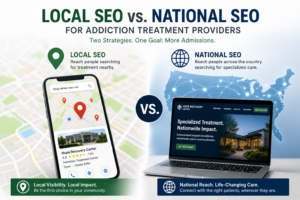
Local and National Search Considerations
A service page can support both local and national visibility, depending on the organization’s model.
A local treatment center may need to communicate its city, service area, facility location, and local relevance.
A national treatment organization may focus more heavily on specialized programs, clinical expertise, travel considerations, and why families may choose treatment outside their immediate area.
For multi-location organizations, each location should have genuinely useful information rather than simply creating duplicate pages with different city names.
User Experience Can Make or Break Conversion
A page can rank well and still underperform.
Why?
The visitor may encounter:
- Too much text before the answer
- Confusing navigation
- Slow page loading
- Weak mobile design
- Difficult-to-find phone numbers
- Unclear contact forms
- Repetitive calls to action
A high-performing page makes the next step obvious without being aggressive.
A visitor should be able to understand the service and find a way to contact admissions without hunting for it.
Common Service Page Mistakes
One Page for Every Treatment Program
This creates thin explanations and makes it difficult to match specific search intent.
Keyword Stuffing
Repeating “rehab,” “drug rehab,” or a city name throughout the page does not create expertise.
Useful information does.
Making Every Page Sound the Same
Detox, residential treatment, IOP, MAT, and dual diagnosis care have different purposes. Their pages should reflect those differences.
Writing Only for Search Engines
If a page sounds unnatural to a family, it is unlikely to perform well as a conversion asset.
Forgetting the Admissions Journey
The visitor needs to know what happens after clicking, calling, or submitting a form.
Clarity reduces friction.
How AI Search Changes Service Pages
AI search systems need enough context to understand what an organization offers and why it is relevant.
That makes clear service descriptions, related concepts, accurate terminology, and trustworthy supporting information increasingly important.
A strong page should make the relationship between the service, population served, treatment approach, location, and level of care easy to understand.
The goal isn’t to write for an algorithm.
The goal is to create information that is so clear and useful that both people and search systems can understand it.
What Should Treatment Centers Do Differently?
Before publishing or redesigning a service page, ask:
- Does the page answer the searcher’s main question immediately?
- Is the treatment clearly defined?
- Is the intended population explained?
- Does the page demonstrate clinical credibility?
- Are related levels of care explained where relevant?
- Is location information accurate?
- Are trust signals easy to find?
- Can visitors quickly contact admissions?
- Does the page provide genuinely useful information?
- Does it accurately reflect the actual program?
If the answer to several of these questions is no, the page probably has more potential.
Turning Service Pages Into Admissions Assets
The strongest rehab websites don’t treat service pages as static descriptions.
They treat them as entry points into the treatment center’s entire digital ecosystem.
A visitor may discover a page through organic search, read related educational content, review the organization’s reputation, explore another level of care, and eventually contact admissions.
That is the real opportunity.
At The Rehab SEO Specialists, we help behavioral health organizations build service pages that combine search visibility, clinical clarity, trust, user experience, and admissions strategy.
If your treatment center has strong programs but your website isn’t communicating their value effectively, schedule a free consultation to discuss how your service pages can become stronger sources of qualified visibility and admissions inquiries.
Frequently Asked Questions
How long should a rehab service page be?
There is no ideal word count. The page should be long enough to answer the important questions thoroughly without adding unnecessary information. Quality and relevance matter more than hitting a specific number.
Should every rehab service have its own page?
Usually, yes. Important services such as detox, residential treatment, PHP, IOP, MAT, and dual diagnosis care can benefit from dedicated pages when they represent genuine programs offered by the organization.
What makes a rehab service page rank well?
Strong search-intent alignment, useful original information, clear topical relevance, credible content, good technical performance, internal linking, local relevance where appropriate, and a strong overall user experience all contribute to performance.
Should a service page include pricing?
If the organization can provide accurate pricing information, explaining costs or insurance considerations can be helpful. If exact pricing varies, clearly explain what influences cost and how prospective patients can obtain accurate information.
How important are reviews on service pages?
Reviews can reinforce trust, but they should complement rather than replace substantive information about the treatment program.
Can one service page target multiple keywords?
Yes, when the keywords represent closely related search intent. The goal is to build a comprehensive resource around the service rather than creating awkward pages for every minor keyword variation.
How can service pages support AI search visibility?
Clear definitions, accurate treatment information, strong topical context, trustworthy sources and credentials, and well-structured answers make it easier for AI systems to understand and summarize the page.
What is the biggest mistake treatment centers make with service pages?
The most common mistake is treating the page as a sales brochure. A high-performing page should first help families understand the treatment and make an informed decision, then provide a clear path to contact admissions.