When a family suddenly needs addiction treatment, they may not begin by researching ten treatment centers. They often start with a simple search: “drug rehab near me,” “detox center near me,” or “alcohol rehab nearby.”
Those searches can put Google Maps directly in the middle of the admissions journey.
For treatment centers, this matters because Google Maps is more than a navigation tool. It can be one of the first places a family encounters your organization, sees your reviews, checks your location, visits your website, and decides whether your center appears trustworthy enough to contact.
A rehab center can have a strong website and excellent clinical programs but still lose local opportunities if its Google Business Profile and Maps presence are neglected.
What Makes Google Maps So Important for Rehab Centers?
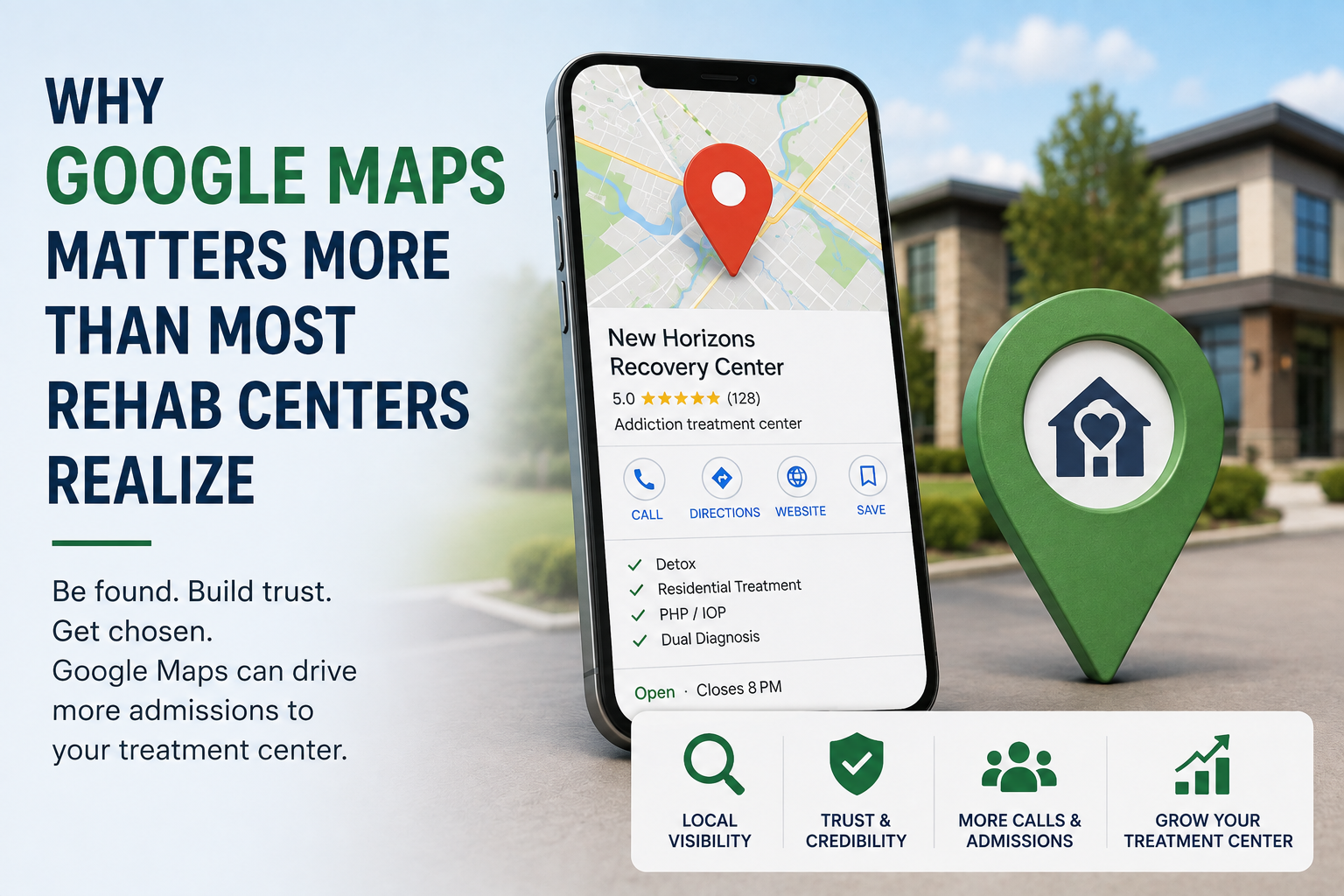
Google Maps connects search intent with local action.
Someone searching for treatment nearby may already have a strong reason to act. They aren’t necessarily browsing for general information. They may be looking for a facility they can contact immediately.
A strong Maps presence can help a treatment center:
- Appear in local searches
- Generate phone calls
- Provide directions
- Showcase reviews
- Introduce services
- Build familiarity
- Drive website visits
- Reinforce credibility
That makes local visibility particularly valuable in behavioral health, where timing and trust can heavily influence admissions.
Why Families Use Maps During Treatment Research
Families often want to know more than whether a treatment center exists.
They may look at:
- Where the facility is located
- How other people describe their experience
- Whether the organization appears established
- Available contact information
- Website and program information
- Photos and facility details
- Recent reviews
In other words, Google Maps becomes part of the trust-building process.
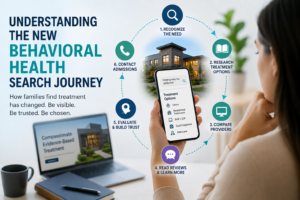
A family may discover your organization through search, evaluate you through Maps, visit your website, and then call admissions. These channels work together.
Google Maps and the Admissions Funnel
Google Maps can influence several stages of the decision.
Discovery
A prospective patient or family searches for addiction treatment in a specific location.
Your organization appears alongside competitors.
Evaluation
The family looks at your reviews, location, business information, website, and overall presentation.
Comparison
They compare your organization with other nearby providers.
Action
If your listing creates enough confidence, the next step may be a phone call, website visit, direction request, or admissions inquiry.
This is why Maps should not be viewed separately from conversion strategy.
Reviews Are More Than a Reputation Metric
A treatment center’s reviews can become one of its most visible trust signals.
Families may look for patterns in recent feedback rather than simply checking the star rating.
They want reassurance that the organization communicates professionally, treats people respectfully, and provides a legitimate treatment experience.
Reputation management therefore deserves to be part of a broader Addiction Treatment Center SEO strategy.
The goal isn’t to manufacture praise. It is to build an authentic reputation by consistently delivering a strong experience and maintaining an accurate, trustworthy public presence.
Google Business Profile Can Strengthen Local Authority
A complete and accurate Google Business Profile helps Google and prospective families understand your organization.
Treatment centers should pay attention to information such as:
- Business name
- Address
- Phone number
- Website
- Business category
- Hours
- Services
- Photos
- Reviews
Inaccurate or outdated information can create friction at exactly the wrong moment.
For multi-location organizations, this becomes even more important. Each location needs accurate information and a local strategy rather than simply duplicating the same approach across every market.
Google Maps Does Not Replace Your Website
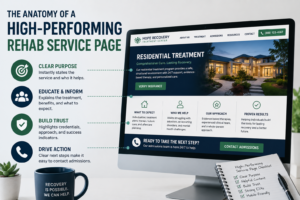
A strong Maps presence should lead into a strong website experience.
Think of the relationship this way:
Google Maps creates the local discovery opportunity. Your website builds deeper confidence. Your admissions team converts that confidence into a conversation.
If someone finds your facility through Maps but lands on a confusing, outdated, or slow website, the opportunity can disappear.
The same applies to the admissions experience.
Marketing, website, and admissions should communicate the same information and expectations.
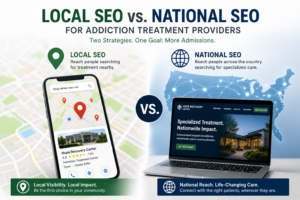
Local SEO and National SEO Serve Different Purposes
Not every treatment search is local.
Some families are looking for a nearby detox center. Others are willing to travel across the country for a specific specialty, clinical approach, or level of care.
That means treatment organizations may need both local and national visibility.
Google Maps is particularly important for local discovery, while broader content strategies can support searches related to specialized programs such as:
- Detox Center SEO
- Residential Rehab SEO
- Outpatient Rehab SEO
- PHP SEO
- IOP SEO
- MAT SEO
- Dual Diagnosis SEO
- Teen Rehab SEO
- Luxury Rehab SEO
- Mental Health Treatment SEO
- Behavioral Health SEO
The strongest strategies connect these service areas rather than treating them as isolated marketing campaigns.
Common Google Maps Mistakes Rehab Centers Make
Treating the Listing as Set-and-Forget
Creating a profile is not the same as managing local visibility.
Organizations should regularly review business information, photos, reviews, services, and other public-facing details.
Ignoring Reviews
A treatment center with a strong clinical reputation but an unmanaged online reputation may leave an incomplete impression.
Using Inconsistent Information
Differences between your website, directories, and Google Business Profile can create confusion and weaken local credibility.
Focusing Only on Rankings
A strong position in Maps is valuable, but what happens after someone sees your listing matters just as much.
The listing, website, reputation, and admissions experience must work together.
How Should Treatment Centers Improve Their Maps Presence?
Start with the basics, then evaluate the entire local patient journey.
Ask:
- Is our Google Business Profile accurate?
- Can families immediately understand what we offer?
- Are our reviews recent and authentic?
- Does our website match the information on Maps?
- Are our location pages useful rather than generic?
- Are phone and contact options easy to find?
- Do our photos and public information reinforce trust?
- Does our admissions team provide the experience our online presence promises?
These questions reveal opportunities that traditional keyword tracking may miss.
Why Google Maps Matters Even More in a Competitive Market
When several treatment centers offer similar levels of care, small differences can influence which provider receives the first call.
A center that appears prominently, has credible reviews, accurate information, useful content, and a professional website may feel safer and more established than a competitor that has neglected its digital presence.
That doesn’t mean Maps alone creates admissions.
It means Maps can determine which organizations get considered in the first place.
For behavioral health operators competing in crowded markets, that first point of visibility can be extremely valuable.
The Future of Local Behavioral Health Search
Search is becoming increasingly connected.
Families may discover a provider through Google Maps, research its website, read reviews, ask an AI platform about the organization, and then contact admissions.
The organizations positioned to benefit will be those with consistent information and strong trust signals across every channel.
Google Maps is therefore not simply a location tool. It is part of the modern behavioral health search journey.
At The Rehab SEO Specialists, we help treatment centers strengthen local visibility through strategic SEO, Google Business Profile optimization, reputation management, content, and AI search strategies designed around the way families actually research care.
If your organization is difficult to find in local search or isn’t converting its online visibility into qualified inquiries, schedule a free consultation to discuss a strategy built around your market, locations, and treatment programs.
Frequently Asked Questions
Does Google Maps really affect rehab admissions?
Yes. Google Maps can introduce families to a treatment center when they are actively searching for nearby care. Reviews, business information, and website links can then influence whether they make contact.
Why is Google Business Profile important for treatment centers?
It helps establish local search visibility and gives families important information about your organization before they visit your website or contact admissions.
Do reviews affect Google Maps visibility?
Reviews are one component of Google’s local ecosystem, and they also influence user trust. Authentic, recent reviews can help families evaluate a treatment provider.
Should every rehab location have its own Google Business Profile?
Each legitimate physical location generally needs its own accurate business presence rather than a single profile representing multiple unrelated locations.
Can Google Maps generate phone calls?
Yes. A Google Business Profile can provide users with a direct way to contact a treatment center, making it an important local conversion opportunity.
Is Google Maps more important than a rehab website?
No. They serve different purposes. Maps helps with discovery and local evaluation, while the website provides deeper information and supports conversion.
How often should a rehab center update its Google Business Profile?
Treatment centers should review their profile regularly and update information whenever business details, services, hours, contact information, or other important details change.
Can national treatment centers benefit from Google Maps?
Yes, particularly when they operate legitimate physical locations. However, national visibility also requires broader SEO and content strategies beyond local search.
What is the biggest Google Maps mistake rehab centers make?
Treating the profile as a one-time setup. Local visibility works best when Maps, reviews, website content, reputation, and admissions experience are managed as one connected strategy.
How can The Rehab SEO Specialists help with Google Maps?
The Rehab SEO Specialists helps behavioral health organizations improve local search visibility, strengthen Google Business Profile performance, build digital authority, and connect local SEO with broader admissions growth strategies.