
Treatment centers often believe they have an admissions problem when they actually have a funnel problem.
At The Rehab SEO Specialists, we’ve found that it’s possible to rank well on Google, invest heavily in paid advertising, receive referral calls, and maintain an active social media presence while admissions remain inconsistent. The missing piece is rarely one marketing channel. More often, it’s the absence of a connected system that guides prospective patients and their families from their first moment of concern to the point where they confidently reach out for help.
Today’s addiction treatment marketing funnel is no longer linear. Families move between Google searches, AI-generated answers, online reviews, treatment directories, Google Maps, YouTube videos, clinician referrals, and your website before making a decision. They compare multiple providers, revisit websites several times, and evaluate trust long before contacting admissions.
Treatment centers that understand this modern decision-making process consistently outperform those focused only on rankings or lead volume.
What Is the Modern Addiction Treatment Marketing Funnel?
The modern addiction treatment marketing funnel is the complete journey a prospective patient or family member takes from recognizing a problem to choosing a treatment provider.
Unlike traditional marketing funnels, today’s version is influenced by multiple search platforms, AI-generated answers, local search results, reputation signals, educational content, referrals, and personal recommendations.
Rather than asking, “How do we generate more leads?” successful organizations ask a better question:
“How do we reduce uncertainty at every stage of the decision?”
That shift changes everything.
Why the Funnel Matters More Than Individual Marketing Channels
Many behavioral health organizations evaluate marketing one tactic at a time.
They ask:
- Is our SEO working?
- Are our Google Ads profitable?
- Should we invest in social media?
- Why aren’t referrals increasing?
Those questions matter, but they overlook the larger system.
Families don’t experience your marketing in isolated pieces.
They experience your organization.
A father searching “drug rehab near me” may first discover your Google Business Profile. Later that evening he reads your website. The next morning he asks ChatGPT to explain treatment options. He watches videos, reads reviews, compares clinical programs, visits another provider’s website, then returns to yours three days later.
Every interaction either builds confidence or introduces doubt.
The marketing funnel connects those moments into one cohesive experience.
The Five Stages of Today’s Addiction Treatment Marketing Funnel
Stage One: Awareness
Everything begins before families know your name.
Searches at this stage often include:
- Signs of addiction
- Alcohol withdrawal symptoms
- When is rehab necessary?
- Detox versus residential treatment
- Helping a loved one accept treatment
Most treatment centers make the mistake of creating content only around branded searches or treatment-specific keywords.
Families rarely start there.
Their first questions are emotional, educational, and uncertain.
Organizations investing in educational resources position themselves as trusted authorities long before admissions conversations begin.
This is where services like Behavioral Health SEO and Mental Health Treatment SEO naturally strengthen visibility across informational searches.
Stage Two: Research and Comparison
Once families accept that professional treatment may be necessary, comparison begins.
This stage has changed dramatically over the past few years.
Instead of reviewing only websites, people now compare information across multiple platforms simultaneously.
They evaluate:
- Google reviews
- AI-generated summaries
- Treatment philosophies
- Clinical credentials
- Accreditation
- Insurance information
- Staff expertise
- Success indicators
- Location
- Website quality
The treatment center with the most polished website doesn’t always win.
The center that answers the family’s questions most clearly usually has the advantage.
Stage Three: Trust Development
Trust has become the true currency of addiction treatment marketing.
Families are making one of the most emotionally significant healthcare decisions of their lives.
Marketing alone cannot create trust.
Evidence does.
Trust develops through consistency.
That includes:
- Helpful educational content
- Transparent program descriptions
- Clearly identified clinical leadership
- Accurate location information
- Authentic reviews
- Consistent branding
- Fast-loading pages
- Accessible admissions information
Every inconsistency creates hesitation.
Small details matter more than many organizations realize.
An outdated Google Business Profile, conflicting phone numbers, missing staff biographies, or vague program descriptions may seem minor internally, yet they introduce friction for families already struggling with uncertainty.
Stage Four: Conversion
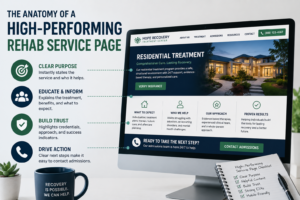
Conversion begins well before someone completes a contact form.
The decision often happens after multiple visits spread across days or weeks.
Treatment centers frequently focus on increasing traffic while overlooking conversion barriers.
Common examples include:
- Difficult navigation
- Generic messaging
- Weak calls to action
- Slow response times
- Missing insurance guidance
- Limited admissions information
Families don’t simply want to know what services you offer.
They want reassurance that you’ve helped people in situations like theirs before.
That reassurance comes from clarity, not exaggeration.
Organizations specializing in Addiction Treatment Center SEO often discover that improving conversion rates produces faster admissions growth than increasing traffic alone.
Stage Five: Admissions Experience
The marketing funnel does not end when the phone rings.
In many organizations, admissions becomes the most overlooked marketing function.
Families judge professionalism through:
- Initial response time
- Compassion
- Clinical knowledge
- Transparency
- Follow-up communication
- Insurance verification process
Every admissions conversation either reinforces or weakens the trust built during earlier stages.
Marketing and admissions should function as one team.
When messaging differs between the website and admissions representatives, confidence declines quickly.
The Biggest Funnel Mistakes Treatment Centers Make
Measuring Traffic Instead of Qualified Intent
Large traffic numbers can create a false sense of success.
Five hundred highly qualified visitors often outperform ten thousand casual visitors.
Behavioral health marketing should prioritize relevance over volume.
Treating SEO as the Entire Strategy
SEO remains critical.
But visibility without trust produces disappointing admissions.
Likewise, excellent admissions teams cannot compensate for poor digital visibility.
Every component supports the others.
Ignoring AI Search Behavior
Families increasingly ask AI platforms questions such as:
- Which rehab centers have dual diagnosis programs?
- What’s the difference between detox and residential treatment?
- Does outpatient rehab work?
Organizations producing structured, trustworthy educational content are more likely to appear in AI-generated answers.
That requires expertise, not keyword repetition.
Forgetting Existing Reputation Signals
Treatment centers often chase new leads while overlooking existing online reputation.
Reviews, clinician mentions, local citations, media coverage, educational resources, and community involvement collectively influence trust.
These signals also influence AI systems evaluating organizational credibility.
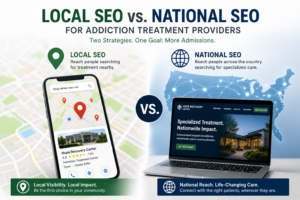
The Funnel Is No Longer Local or National
It Is Both
Years ago, organizations often chose between local SEO and national SEO.
Today those boundaries overlap.
Someone relocating a family member for treatment may search nationally.
Another family wants care within twenty minutes of home.
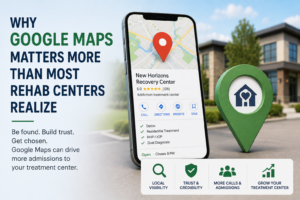
Both groups may encounter your organization through Google Maps, AI search, or organic search results.
An effective strategy supports both discovery paths simultaneously.
This becomes especially important for providers offering services such as Detox Center SEO, Residential Rehab SEO, PHP SEO, IOP SEO, MAT SEO, Luxury Rehab SEO, Teen Rehab SEO, Sober Living SEO, and Dual Diagnosis SEO, where search intent varies significantly across programs.
What High-Performing Treatment Centers Do Differently
The strongest organizations rarely chase every new marketing trend.
Instead, they create systems.
They publish educational resources that genuinely answer family questions.
They maintain accurate business information across platforms.
They invest in clinician credibility.
They strengthen admissions processes.
They improve user experience.
They measure qualified inquiries rather than vanity metrics.
Most importantly, they understand that marketing is not about persuading families.
It’s about helping families feel confident in a difficult decision.
That distinction creates stronger brands and more sustainable admissions growth.
The Future of Addiction Treatment Marketing Funnels
Search behavior continues to evolve.
Google increasingly surfaces direct answers instead of simple lists of websites.
AI assistants summarize information before users ever click a link.
Families consume information from multiple devices throughout the day.
This doesn’t reduce the importance of SEO.
It expands it.
The organizations that thrive will create authoritative resources that educate, answer questions, demonstrate clinical expertise, and build trust wherever families encounter them.
The funnel becomes less about generating attention and more about becoming the most credible source of information throughout the decision-making journey.
Building a Funnel That Supports Long-Term Admissions Growth
An effective addiction treatment marketing funnel isn’t a collection of disconnected tactics. It’s a coordinated system designed to reduce uncertainty, build trust, and guide families through one of the most important healthcare decisions they will ever make.
When every stage of the journey works together, from educational content and search visibility to admissions conversations and follow-up, treatment centers are better positioned to attract qualified inquiries instead of simply generating more traffic.
At The Rehab SEO Specialists, we help behavioral health organizations build marketing systems that support sustainable admissions growth through strategic visibility, trustworthy content, and patient-centered digital experiences that align with how families actually search today.
Frequently Asked Questions
What is an addiction treatment marketing funnel?
An addiction treatment marketing funnel is the complete process that moves prospective patients and families from initial awareness through research, trust-building, inquiry, admissions, and enrollment.
Why is the marketing funnel important for rehab centers?
It helps treatment centers understand where prospective patients disengage, allowing them to improve visibility, trust, and conversion rates rather than focusing only on lead generation.
Is SEO enough to generate consistent admissions?
No. SEO creates visibility, but admissions growth also depends on trust, user experience, reputation management, and effective admissions processes.
How has AI changed addiction treatment marketing?
AI platforms increasingly answer healthcare questions directly, making authoritative, well-structured educational content more valuable than ever for visibility and credibility.
What stage of the funnel do most treatment centers overlook?
Many organizations underestimate the trust-building stage, where families compare providers, evaluate credibility, and seek reassurance before contacting admissions.
Should marketing and admissions teams work together?
Yes. Consistent messaging between marketing and admissions improves trust and creates a smoother experience for prospective patients and families.
How long does the decision-making process usually take?
It varies widely. Some families seek immediate placement during a crisis, while others spend days or weeks researching providers before reaching out.
Does local SEO still matter for addiction treatment centers?
Absolutely. Even organizations serving national audiences benefit from strong local visibility because many searches begin with geographic intent or Google Maps.
What metrics matter more than website traffic?
Qualified inquiries, admissions, conversion rates, engagement quality, and patient fit provide far more meaningful insight than traffic alone.
What should treatment centers prioritize first?
Begin by understanding the complete patient journey. Then strengthen each stage of the funnel, ensuring educational content, digital visibility, reputation, website experience, and admissions processes work together rather than independently.