If you’ve shopped for rehab SEO pricing lately, you’ve seen everything from $500 “all-in” packages to multi-thousand-dollar retainers. The spread is confusing—until you look under the hood. In addiction treatment, SEO lives in a YMYL (Your Money or Your Life) category where accuracy, compliance, and trust literally affect people’s health decisions. That reality makes the work deeper (and frankly, more expensive) than generic SEO. This guide breaks down where the money goes, what corners you shouldn’t cut, and how to evaluate proposals with a clear eye.
Why Rehab SEO Pricing Looks Different From Other Industries
Treatment-center SEO isn’t just keywords and meta tags. It’s clinical nuance, regulated language, and E-E-A-T (Experience, Expertise, Authoritativeness, and Trustworthiness). A solid program must:
- Align with HIPAA and platform policies.
- Use medically accurate language for withdrawal, detox, and levels of care.
- Avoid misleading claims and prohibited superlatives.
- Map complex user intent—from crisis queries (“alcohol withdrawal timeline”) to commercial intent (“IOP near me”).
That blend of content quality, technical rigor, and risk management requires specialists, not commodity vendors.
Cheap Packages vs. Specialist Agencies
The $500–$1,500 “Templated” Package
What you usually get:
- A set of recycled pages with city-name swaps.
- Think “what is [drug]?” posts pulled from public sources.
- A handful of low-quality directory links.
- Surface-level reporting (rank screenshots, maybe Google Analytics logins).
Risks: Duplicate content, inaccurate medical info, and links from spammy sites that harm you long-term. You might see a small bump on obscure keywords, but high-intent queries in competitive metros won’t budge.
The $3,000–$10,000+ Specialist Retainer
What you should expect:
- Clinical-grade, original content mapped to the entire patient journey.
- Technical SEO, page-speed and accessibility improvements, schema, and crawl strategy.
- Editorial link building and digital PR on sites with real traffic and topical relevance.
- Local SEO strategy across multiple locations, including GBP post cadence and review ops.
- Analytics tied to admissions outcomes, not just impressions.
Results: Slower at first, steadier over time. Rankings compound, cost per admission drops, and your brand builds defensible topical authority.
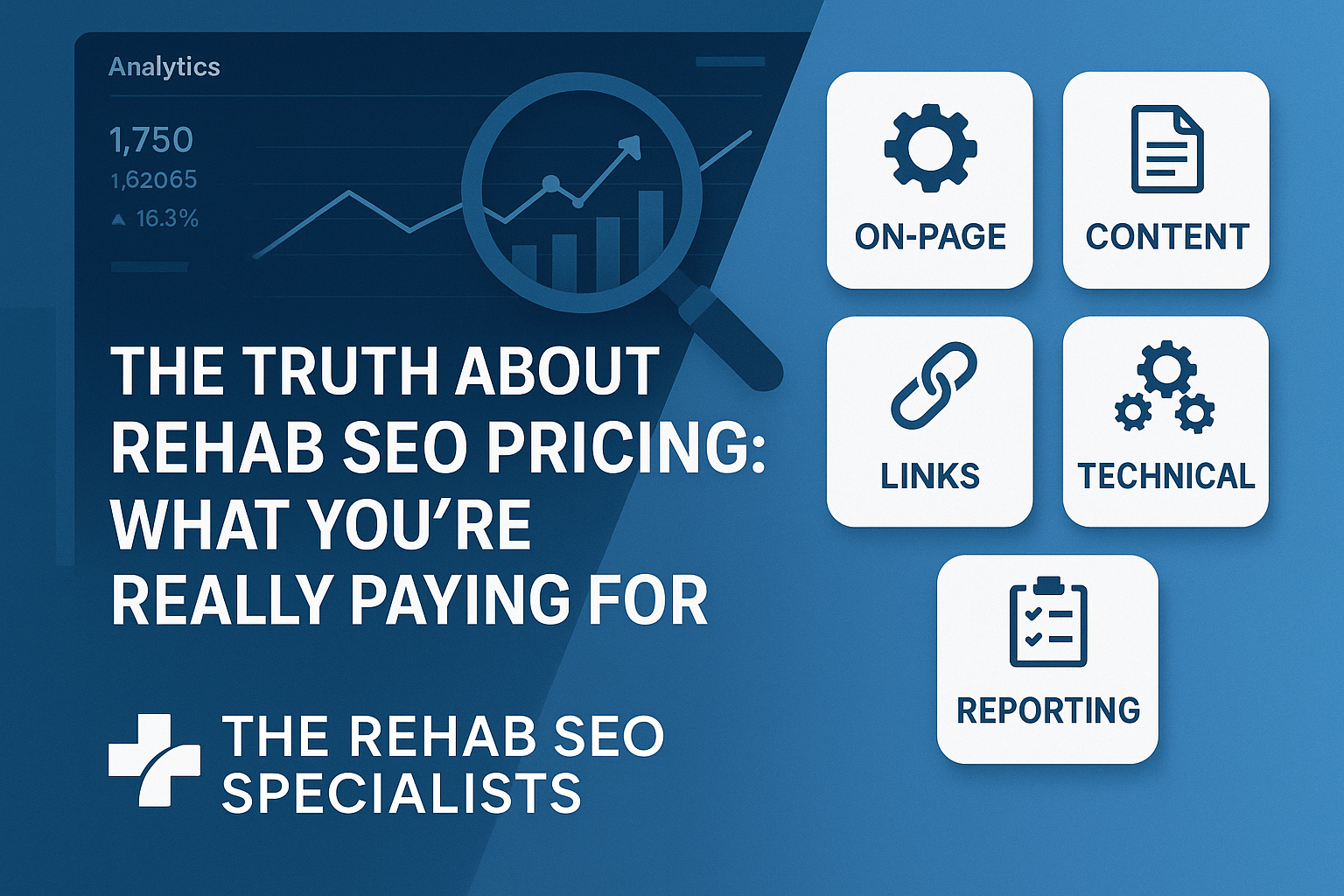
What Goes Into Rehab SEO Pricing (Line by Line)
1) Discovery, Research & Strategy (One-Time or First 30–60 Days)
What’s involved: Competitive gap analysis, keyword clustering by intent (informational > commercial > navigational), patient journey mapping, and compliance review of existing content. For multi-location providers, this includes location architecture and internal linking plans.
Typical investment: $2,000–$6,000 depending on size and number of locations.
Red flags to avoid: Proposals that skip research or deliver a “strategy” in a single call.
2) On-Page SEO & Site Architecture
What’s involved: Title/meta rewrites, header hierarchy, entity optimization, internal links, medical/FAQ schema, and UX edits that affect conversion (CTA placement, trust signals, contact options).
Typical investment:
- Initial overhaul: $1,500–$4,000 for small sites; more for multi-state networks.
- Ongoing: Baked into the monthly retainer (see below).
Corner not to cut: Information architecture. If your detox, residential, PHP, and IOP pages aren’t clearly separated (and interlinked with supporting content), you’ll struggle to rank for level-of-care terms.
3) Content Creation (The Heavy Lifter)
What’s involved: Original, medically reviewed pages and articles that build topical authority—detox protocols, medication-assisted treatment, withdrawal timelines, family resources, and localized city pages with real substance.
Quality ranges:
- Expert blog/guide (1,200–1,800 words): $350–$900 each (includes SME review and optimization).
- Core service page (1,000–1,400 words): $500–$1,200 (higher if multiple stakeholders or advanced design).
- City/location page: $300–$700 (must be unique, not doorway pages).
- Thought leadership/medical reviewer fees: Additional.
Corner not to cut: Medical accuracy and originality. Google’s quality raters scrutinize YMYL content; thin or generic writing invites demotion.
For a deeper look at content strategy in the treatment space, see our overview of Rehab SEO Services and how we structure content to match clinical intent.
4) Link Building & Digital PR
What’s involved: Earning editorial links from addiction/mental health publications, universities, credible news, and high-quality directories. Tactics include expert commentary (HARO/featured quotes), proprietary research, city- or state-specific guides, and partnerships with nonprofits.
Typical investment:
- Per acquired link: $300–$1,000+ depending on authority and effort.
- Monthly programs: $1,500–$5,000 for 4–10 quality placements.
Corner not to cut: Relevance and authenticity. Avoid vendors selling “DA-only” links or private blog networks. Rehab SEO requires a clean link profile; toxic links may take months to disavow.
5) Technical SEO & Audits
What’s involved: Crawl budget optimization, log-file analysis, Core Web Vitals, index bloat cleanup, canonicalization, internationalization issues (if any), structured data, and accessibility improvements that aid engagement.
Typical investment:
- Full technical audit: $2,000–$6,000 depending on site size/complexity.
- Remediation sprint: $1,000–$4,000 (or included in retainer).
Corner not to cut: Index hygiene. Bloated archives, duplicate location pages, and thin tag/category indexes dilute authority across your domain.
6) Local SEO (Multi-Location Complexity Adds Cost)
What’s involved: Google Business Profile optimization and posting, service and product configuration, review generation workflows, citation cleanup, and localized content silos that mirror physical catchment areas.
Typical investment:
- Per location setup/cleanup: $400–$1,200 one-time.
- Ongoing per location: $150–$400/month for posts, Q&A, photo cadence, and review ops.
Corner not to cut: Review operations. A predictable stream of recent, high-quality reviews with service keywords is a map-pack differentiator.
7) Analytics, Call Tracking & Monthly Reporting
What’s involved: GA4, GSC, Looker Studio dashboards, dynamic number insertion (DNI), CRM integration, and pipeline-level attribution (click > call > qualified lead > admission). Reporting should tell you which pages generated calls and which calls became admissions.
Typical investment:
- Setup (one-time): $500–$2,000.
- Ongoing reporting/analysis: Included in retainer; premium models add $300–$800/month for advanced attribution.
Corner not to cut: Attribution. If you can’t see which content and markets produce admissions, you’ll overspend on the wrong tactics.
What a Realistic Monthly Retainer Buys
For a single-location center in a competitive metro, expect $3,500–$7,500/month for an expert agency delivering:
- 2–4 high-quality articles or one major guide + one service page.
- Ongoing on-page optimization and internal linking.
- 3–8 genuine editorial/citation links.
- Local SEO management (GBP posts, review ops).
- Technical maintenance and reporting tied to admissions.
Multi-location and multi-state enterprises commonly invest $8,000–$20,000+/month, scaled by locations, languages, and service lines.
Rule of thumb: If a quote is dramatically lower, something essential is missing (content depth, link quality, or technical stewardship). If it’s dramatically higher, demand clarity on deliverables and measurable outcomes.
How to Evaluate Proposals (A Short Checklist)
- Deliverables by month: Exact number of pages, links, technical hours.
- Quality assurances: Who writes? Who medically reviews? Provide samples.
- Link standards: Real sites with traffic, topical relevance, no PBNs.
- Local plan: What’s the cadence for GBP posts, reviews, and citations?
- Attribution: How will calls and forms map to content and location pages?
- Time-to-value: Leading indicators (indexation, impressions, map pack visibility) before admissions ramp.
- Ownership: You keep content, links, and analytics access if you part ways.
Where to Invest—and What Not to Skimp On
Invest in:
- Authoritative, medically accurate content mapped to each level of care.
- Editorial links with relevance, not just “high DA.”
- Technical hygiene that keeps your best pages fast and crawlable.
- Local SEO systems that scale by location and service line.
- Attribution that ties SEO to admissions, not vanity metrics.
Don’t skimp on:
- Medical review and compliance.
- Information architecture and internal linking.
- Ongoing content updates to reflect clinical best practices.
The Bottom Line on Rehab SEO Pricing
You’re not buying blog posts or backlinks—you’re buying qualified admissions, lower cost per admit, and a durable brand moat in a sensitive, highly scrutinized vertical. That takes expertise, process, and time. The cheapest option rarely survives the first algorithm update, while strategic, specialist work compounds.
If you want an honest assessment of where your current budget is going—and how to reallocate toward the levers that move admissions – The Rehab SEO Specialists can help. Explore how we structure engagements on our services page, or Schedule a free strategy session today. We’ll show you exactly what to prioritize, what to pause, and how to make every dollar work harder.